
When banks and fintech companies say they’re “adding crypto,” it sounds deceptively simple - like just another button in the app. In reality, it’s more like opening a branch in a parallel universe: with different rules, language, and pace.
Web3 promises a future where users truly own their assets, and brands earn loyalty without intermediaries. Yet, while some are busy building metaverses, businesses face far more grounded questions: how do you even integrate crypto wallets without burning an IPO-level budget?
The market is evolving. What was once a playground for enthusiasts has now become a competitive space where major banks and fintechs are hunting for white-label solutions to offer clients secure and scalable crypto services.
And no one wants to build everything from scratch. Why? Because it’s expensive and time-consuming. Meanwhile, the market won’t wait - by the time you finalize your architecture, a competitor is already testing Wallet-as-a-Service.
Fintech companies that decide to add crypto support quickly realize: a wallet is not just a feature - it’s an entire ecosystem. Each token requires its own logic, APIs, protocols, nodes, and updates. For example:
• Bitcoin support means dealing with tens of gigabytes of blockchain data and its own fee calculation system.
• Ethereum involves smart contracts, gas fees, and transaction validation.
• USDT? Depends on the network - ERC-20, TRC-20, BEP-20. Three different worlds, three different headaches.
Now multiply all of this by 50 coins. Add AML/KYC requirements, transaction monitoring, double-spend protection, and fraud detection. This is where many teams start rethinking budgets - and quietly move the “release this quarter” milestone to the next one.
In conclusion, the realities are:
• For banks, a crypto wallet is a risky innovation that must fit into compliance and regulatory frameworks.
• For fintechs, it’s a natural step in evolution - but with hidden costs that multiply quickly.
So, your fintech company has decided to work with crypto. You have two paths ahead: Build - develop wallets in-house, or Buy - use a ready-made white-label solution, like WaaS. On paper, it seems simple - but in practice… the real show begins.
One London-based team spent three months integrating a popular token. Everything went perfectly… until an internal audit said: “Guys, your AML/KYC system failed the check.” The result? Complete rework from scratch. Money, time, nerves - all lost.
The upside: you have full control over the product. But, this requires suffering and owning every line of code. The downside: you risk burning out before a single client makes a deposit.
A small fintech company in Berlin integrated WaaS and was testing its first client deposits within a week. Developers didn’t spend sleepless nights arguing about token nuances - they could focus on unique product features. Clients got a working experience - without a million-dollar dev team.
The bottom line: you save time, money, and sanity, while delivering a product that actually works. In fintech, this is like finding a shortcut through the jungle - you get there faster and safer.
If the previous Build vs Buy comparison made you think, it’s time to look at real tools that actually work. Now, let’s talk about Wallet-as-a-Service (WaaS) - a ready-made tool for managing crypto wallets without a million-dollar development team. Let’s see how this works in practice through two examples:
Coinbase positions its WaaS as a tool for those who want to stay in control of every element of their infrastructure.
Key features:
• Security via MPC - private keys are split between the user and the platform, reducing the risk of device compromise.
• Support for multiple blockchains - EVM networks and other blockchains provide flexibility for integration into existing ecosystems.
• Simple integration via API and SDK - quick deployment of crypto wallets into applications, with standard user authentication.
• Key management and recovery - backup and recovery options give the team peace of mind.
WhiteBIT focuses on automation and a ready-to-use infrastructure.
Key features:
• AML/KYC compliance - follows international standards for identification and anti-money laundering, including necessary client verification procedures.
• No technical overhead - security, storage, and updates are handled by the provider.
• Business scalability - easily handles growing transaction volumes and an increasing number of users.
• Seamless integration - fintech platforms can effortlessly integrate crypto wallets into their services without the need to build their own infrastructure.
• Multi-blockchain support - a multichain wallet enables users to receive cryptocurrency on one network and send it across another.
• Focus on product and clients - the company can concentrate on interface, analytics, and new features rather than the technical side.
• Wallet address generation - users can create wallet addresses for multiple cryptocurrencies simultaneously.
Choosing the right infrastructure is less about “saving money” and more about survival: maintaining speed, avoiding operational blind spots, and keeping your product ready for tomorrow’s token.
Ironically, the real edge comes not from doing everything yourself, but from mastering the strategy of selective delegation - letting the tech handle the heavy lifting while your team drives growth, insights, and user trust. In this arena, clever orchestration beats raw effort every time.
On-Chain Media articles are for educational purposes only. We strive to provide accurate and timely information. This information should not be construed as financial advice or an endorsement of any particular cryptocurrency, project, or service. The cryptocurrency market is highly volatile and unpredictable.Before making any investment decisions, you are strongly encouraged to conduct your own independent research and due diligence
Tags :

0 Comments
Show More

Nvidia falls as AI-safety concerns, DOJ scrutiny of its $17 billion Groq licensing deal and profit-taking pressure weigh on shares.

Bitcoin faces rising Fed rate-hike odds, a hawkish ECB, and a make-or-break Senate cloture vote on the CLARITY Act — all landing in the same five-day window.
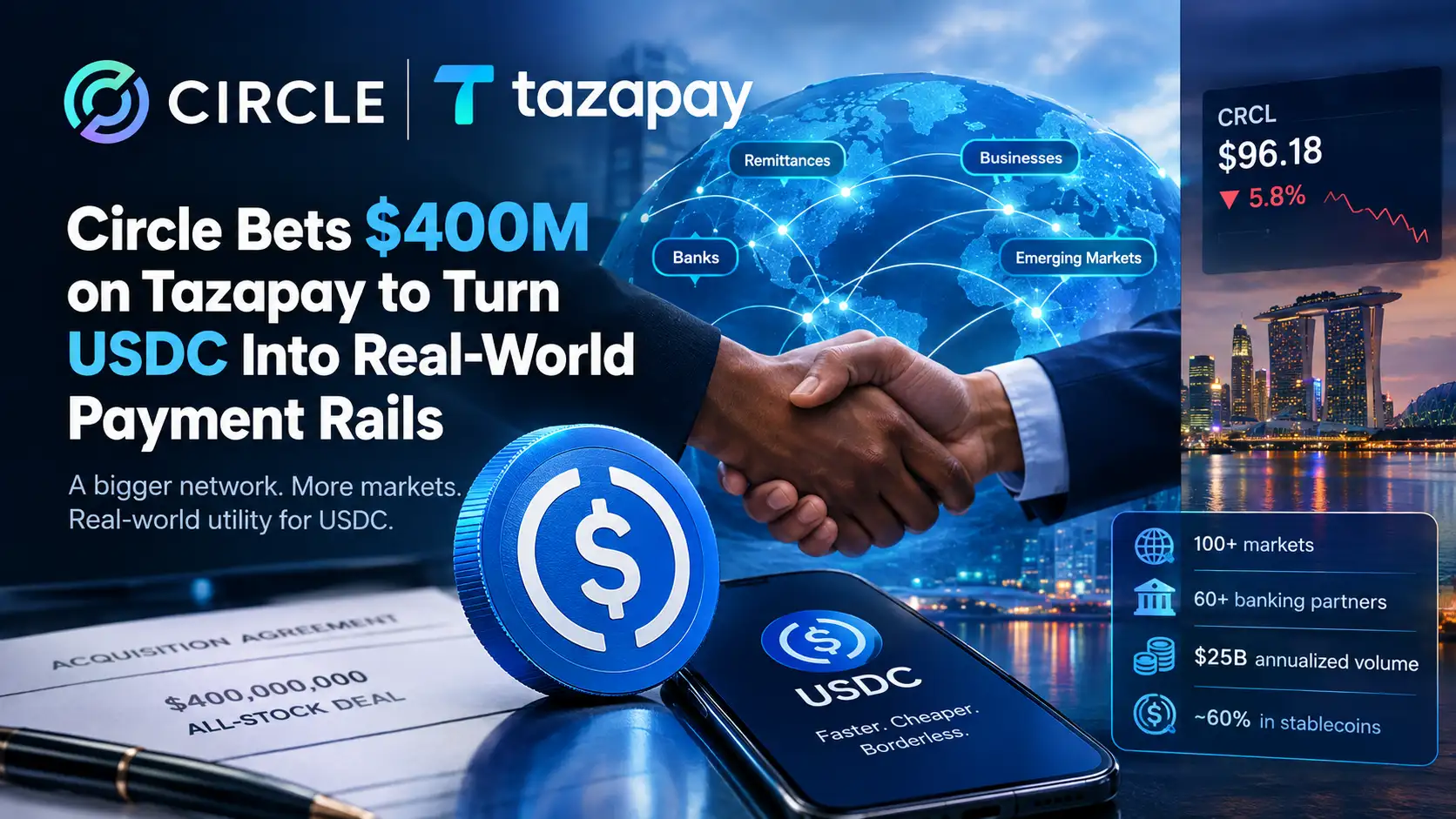
Circle's largest deal since Poloniex brings a licensed cross-border payments network in-house.
On-Chain Media is an independent, reader-funded crypto media platform. Kindly consider supporting us with a donation.
bc1qp0a8vw82cs508agere759ant6xqhcfgcjpyghk
0x18d7C63AAD2679CFb0cfE1d104B7f6Ed00A3A050
CBaXXVX7bdAouqg3PciE4HjUXAhsrnFBHQ2dLcNz5hrM
Contains the last 12 releases