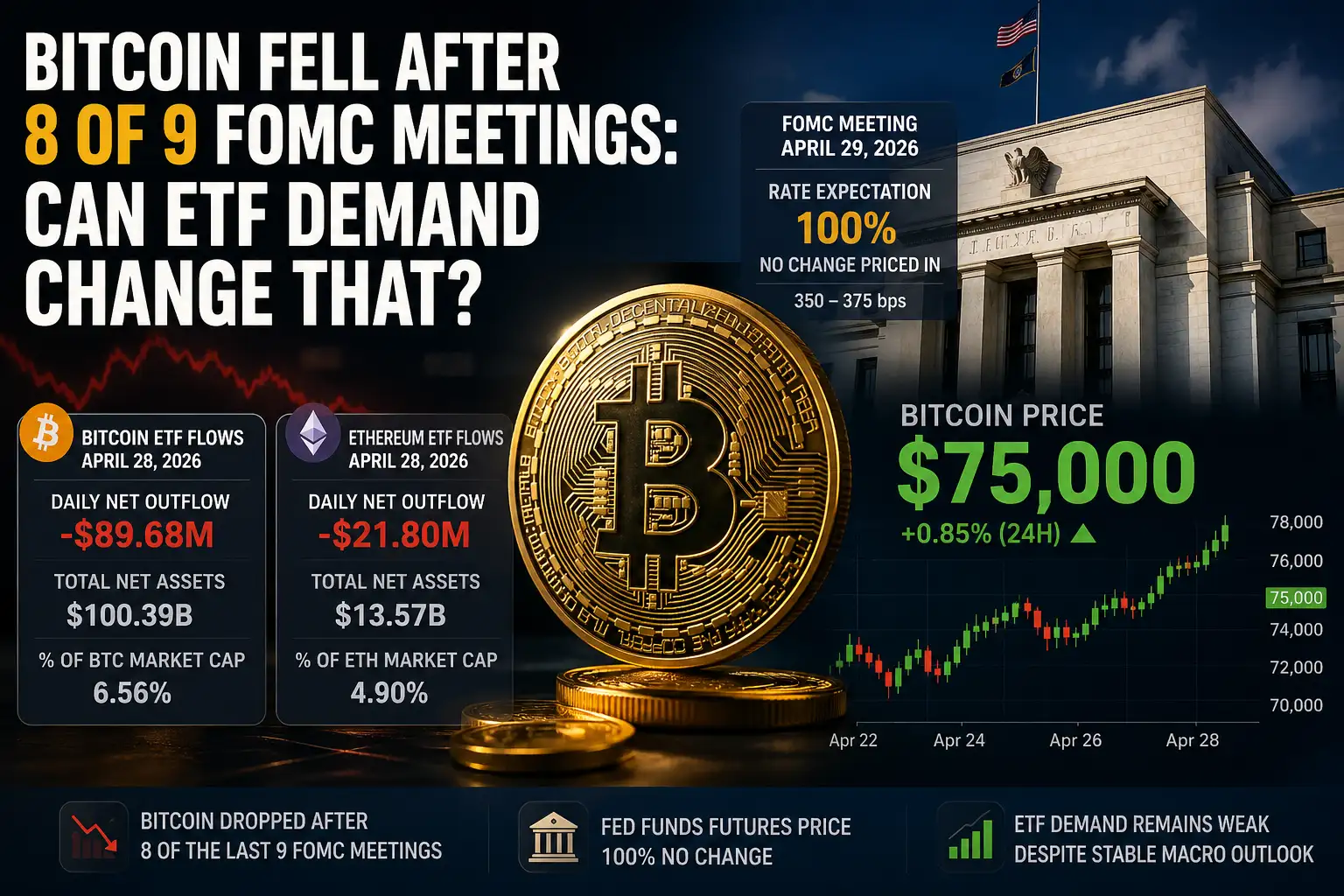
Bitcoin traded near $75,000 as markets entered the April FOMC meeting with no rate change expected. Futures priced a full hold, while ETF flows turned negative and pressured sentiment.
The setup created a clean macro backdrop, yet weak demand raised questions about post-meeting direction.
Bitcoin traded at approximately $75,270 during the session, reflecting a slight daily decline. Price action stayed subdued as markets absorbed a fully priced Federal Reserve outcome. However, historical patterns showed Bitcoin declined after eight of the last nine FOMC meetings.
Futures markets assigned a 100% probability to no rate change for the April meeting. The target range remained between 350 and 375 basis points across contracts. This positioning removed uncertainty and shifted focus toward forward guidance and liquidity signals.
Meanwhile, spot Bitcoin ETFs recorded a combined net outflow of $89.68 million. BlackRock’s IBIT led activity with over $1 billion in trading volume. Despite that, the fund posted the largest outflow, which signaled reduced short-term demand.
Fidelity’s FBTC also recorded outflows, though at a smaller scale during the session. Bitwise’s BITB followed with additional negative flow, reinforcing the broader trend. However, ARK 21Shares’ ARKB stood out with notable inflows against the market direction.
Grayscale’s GBTC and other smaller funds showed no net inflows during the day. Prices across ETF products declined modestly, reflecting broader market weakness. This combination of steady macro conditions and weaker flows placed Bitcoin in a positioning-driven phase.
Historically, Bitcoin reacts to FOMC outcomes regardless of the policy decision. However, current pricing reduces the chance of a rate-driven surprise. As a result, market direction may depend more on liquidity expectations and risk appetite shifts.
Ethereum traded near $17.37 across major ETF-linked products, posting modest daily gains. Prices rose slightly even as ETF flows remained negative across most funds. This divergence highlighted steady demand in price action despite weak institutional flows.
Spot Ethereum ETFs recorded a total daily net outflow of $21.80 million. BlackRock’s ETHA led trading volume with over $325 million in activity. However, it also posted the largest outflow among listed Ethereum products.
Grayscale’s ETHE and Fidelity’s FETH added to the negative flow trend. Despite this, their market prices increased slightly during the session. This pattern suggested that price momentum held even as capital exited ETF structures.
Several smaller Ethereum ETFs reported no net flows during the same period. Products from VanEck, Franklin, and Invesco maintained stable positions without new capital movement. At the same time, their prices posted moderate gains across the board.
Ethereum’s total ETF asset base stood at $13.57 billion after the update. This represented a smaller share of market capitalization compared to Bitcoin ETFs. Still, the steady price increase indicated underlying support beyond ETF activity.
The broader context showed Ethereum maintaining resilience during mixed signals from institutional demand. While ETF flows remained negative, price gains suggested ongoing market participation. This dynamic kept Ethereum stable despite external pressure from outflows.
Markets entered the FOMC meeting with no expectation of a rate change. Futures contracts removed the probability of both hikes and cuts before the announcement. This environment reduced volatility linked to policy uncertainty.
Bitcoin’s reaction now depends more on Federal Reserve communication than rate action. Guidance on inflation and liquidity could shape short-term sentiment. Traders often adjust exposure quickly following central bank signals.
ETF demand plays a growing role in Bitcoin’s price structure. Strong inflows previously supported upward momentum across multiple sessions. However, recent outflows indicate a pause in that support mechanism.
Ethereum reflects a similar trend, though with smaller scale ETF participation. Price gains during outflows suggest a more balanced demand structure. This contrast highlights differences in how each asset responds to institutional flows.
Overall, crypto markets now sit between stable macro conditions and weakening ETF demand. The absence of rate surprises shifts attention toward liquidity signals and positioning. This phase may define near-term direction across major digital assets.
On-Chain Media articles are for educational purposes only. We strive to provide accurate and timely information. This information should not be construed as financial advice or an endorsement of any particular cryptocurrency, project, or service. The cryptocurrency market is highly volatile and unpredictable.Before making any investment decisions, you are strongly encouraged to conduct your own independent research and due diligence
Tags :

0 Comments
Show More
XRP faces mounting bearish pressure as whales sell millions of tokens and network activity declines.

Tether is integrating USDT wallet technology into Neura Robotics' autonomous robots, allowing them to receive crypto payments for completed tasks.

AI-related mentions in SEC filings and investor presentations surged to a record 46,000 in Q1 2026, according to
On-Chain Media is an independent, reader-funded crypto media platform. Kindly consider supporting us with a donation.
bc1qp0a8vw82cs508agere759ant6xqhcfgcjpyghk
0x18d7C63AAD2679CFb0cfE1d104B7f6Ed00A3A050
CBaXXVX7bdAouqg3PciE4HjUXAhsrnFBHQ2dLcNz5hrM
Contains the last 12 releases