Space commercialization has entered a new era—and Copernic Space is writing the playbook. With the historic success of Moon Mission I, the launch of cultural and commercial assets to the lunar surface, and the imminent expansion into on-orbit computation and AI deployment, Copernic Space has already achieved what many thought impossible: making space an accessible, ownable, and tradable economy through blockchain and tokenization.
At the helm of this revolution is Grant Blaisdell, co-founder and CEO of Copernic Space, a platform reshaping how we value, access, and interact with outer space. From the Moon to low Earth orbit, Copernic is building the first commercial infrastructure for owning, trading, and monetizing real-world space assets—and soon, intelligent agents and code running in orbit.
We sat down with Blaisdell to explore how the company went from vision to lunar mission, and how their upcoming launches will unlock space not just as a destination, but as a computational and creative economy.
Grant Blaisdell: We’ve gone from a bold idea—tokenizing space—to actually putting the first tokenized cultural assets on the Moon and enabling people to commercially own a part of that mission.
That’s never been done. With Moon Mission I, we proved that space is no longer exclusive to governments or billion-dollar companies. Space is now a marketplace, and Copernic Space is the protocol behind it.
Now we’re expanding beyond payloads. Through our infrastructure partners, we're commercializing in-orbit compute—letting users deploy code, run AI models, beam data up and down, and launch intelligent agents that operate autonomously in space. All tokenized. All tradable. That’s not just access to space—that’s access to space-based economies.
Moon Mission I wasn’t just a technical milestone. It was a cultural and commercial leap. We enabled the world’s first digital twin sculptures on the Moon by Marco Olivier, and "Vision of Unity & Peace" by artist Ehsan—a message from humanity, embedded in lunar regolith forever. But more than that, those assets were tokenized, fractionalized, and made available to collectors, investors, and brands.
This created the first real-world lunar space assets on-chain. Not only does that expand what art and culture can be, but it sets the precedent for how space property rights and intellectual value in orbit will be established and exchanged.
We're already enabling a another Moon payload scheduled for the end of the year, and our upcoming missions go far beyond delivery. We’re offering tokenized AI and computational infrastructure on satellites in orbit as a service accessible to the wider commercial market.
That means:
You’ll be able to lease compute time, sell AI-generated content from orbit, and launch your own intelligent payload—all verifiable and commercialized through tokenization on our platform and through Above Space.
Tokenization is the backbone of this. Every payload slot, AI execution, or data product becomes a verifiable, ownable, and tradable asset—what we call Real World Space Assets (RWSAs). These are NFTs with smart contract functionality that lets them carry revenue rights, IP licenses, or mission metadata.
Imagine launching a generative AI that creates shoe designs in orbit. The results? Automatically minted and sent back to Earth as tokenized products, with the original computational payload as a permanent on-chain asset. A new form of IP, asset, and interplanetary product development.
Space is open. For artists: this is a new medium and asset class for their works whether its on moon mission, rockets, satellites etc. For investors: it's an emerging asset class.
For builders: it’s compute infrastructure in a new domain. Our platform connects you directly to the missions and payloads, lets you own a piece of them, and enables new types of value creation at orbital and lunar levels. You don’t need to build a rocket to participate—you just need an idea, some code, or a community. And we’ll get you to space.
Space is now an accessible economy and asset class that you can own, trade, and create in. From tokenized Moon missions to orbital AI, the future of space isn’t science fiction anymore. It’s programmable, purchasable, and already here.
As Blaisdell puts it: “The same way the internet changed how we connect, space will change how we compute, create, and commercialize. And we’re building the economic rails for that future.”
On-Chain Media articles are for educational purposes only. We strive to provide accurate and timely information. This information should not be construed as financial advice or an endorsement of any particular cryptocurrency, project, or service. The cryptocurrency market is highly volatile and unpredictable.Before making any investment decisions, you are strongly encouraged to conduct your own independent research and due diligence
Tags :

0 Comments
Show More

Nvidia falls as AI-safety concerns, DOJ scrutiny of its $17 billion Groq licensing deal and profit-taking pressure weigh on shares.

Bitcoin faces rising Fed rate-hike odds, a hawkish ECB, and a make-or-break Senate cloture vote on the CLARITY Act — all landing in the same five-day window.
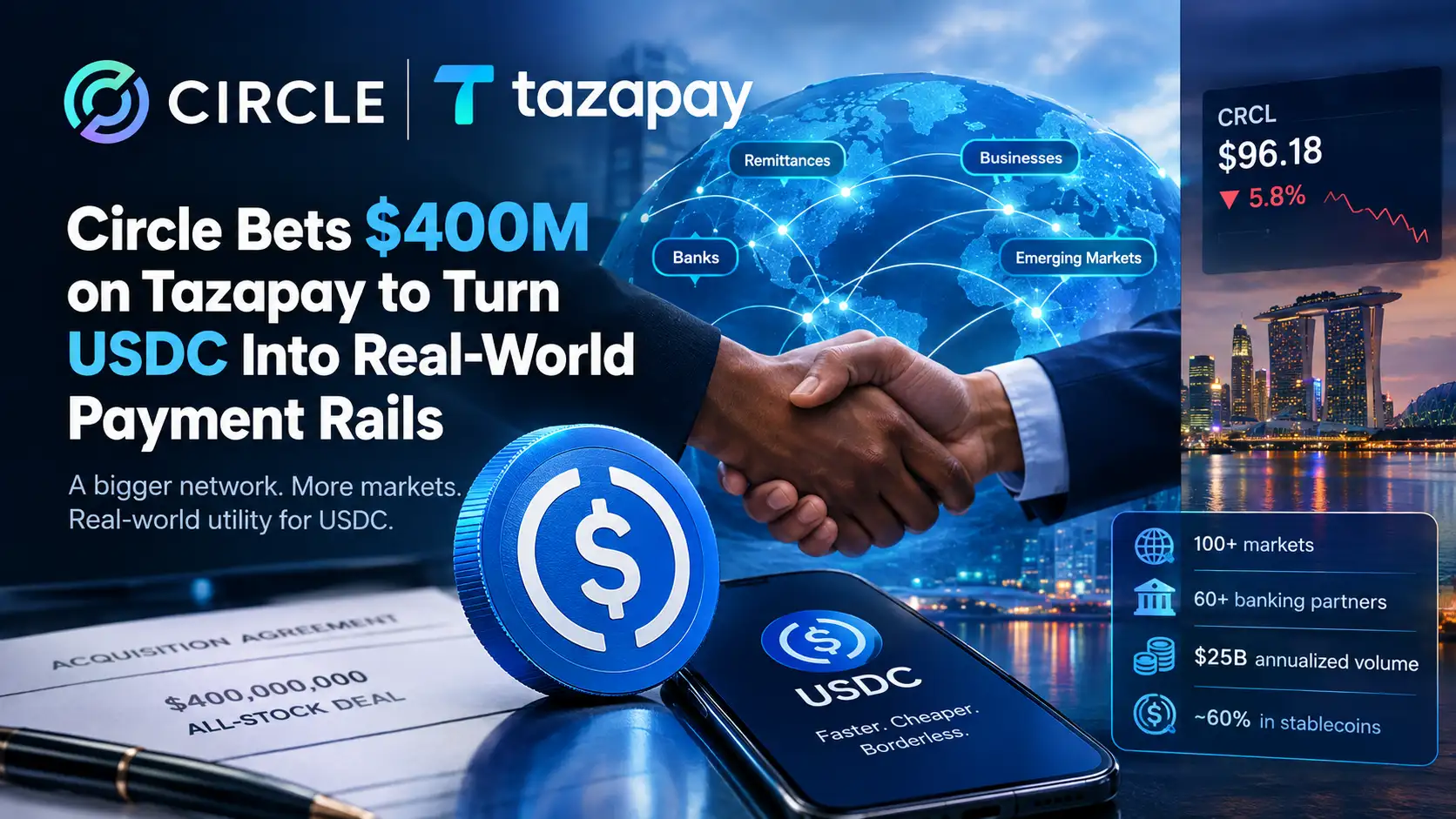
Circle's largest deal since Poloniex brings a licensed cross-border payments network in-house.
On-Chain Media is an independent, reader-funded crypto media platform. Kindly consider supporting us with a donation.
bc1qp0a8vw82cs508agere759ant6xqhcfgcjpyghk
0x18d7C63AAD2679CFb0cfE1d104B7f6Ed00A3A050
CBaXXVX7bdAouqg3PciE4HjUXAhsrnFBHQ2dLcNz5hrM
Contains the last 12 releases